
 Lauryn Dell
The sewing basket lived on the kitchen chair, and the dog learned the sound of it. A spool knocked the table. Scissors clicked. He settled closer, because a project on that table usually ended on him.
Yarn dust got into the sun on the linoleum. A pin waited in the hem of the curtain where somebody parked it, point first. The house smelled like cotton and the iron, and his bed was never far from the cord of the iron.
American kitchens turned scraps into his things. A shirt that no longer buttoned. A sock with a thin heel. A length of cord. Nobody called it a craft hour. They called it Tuesday, and he was already waiting for the result.
#18 Hexagon patches, pins, and a wooden spool
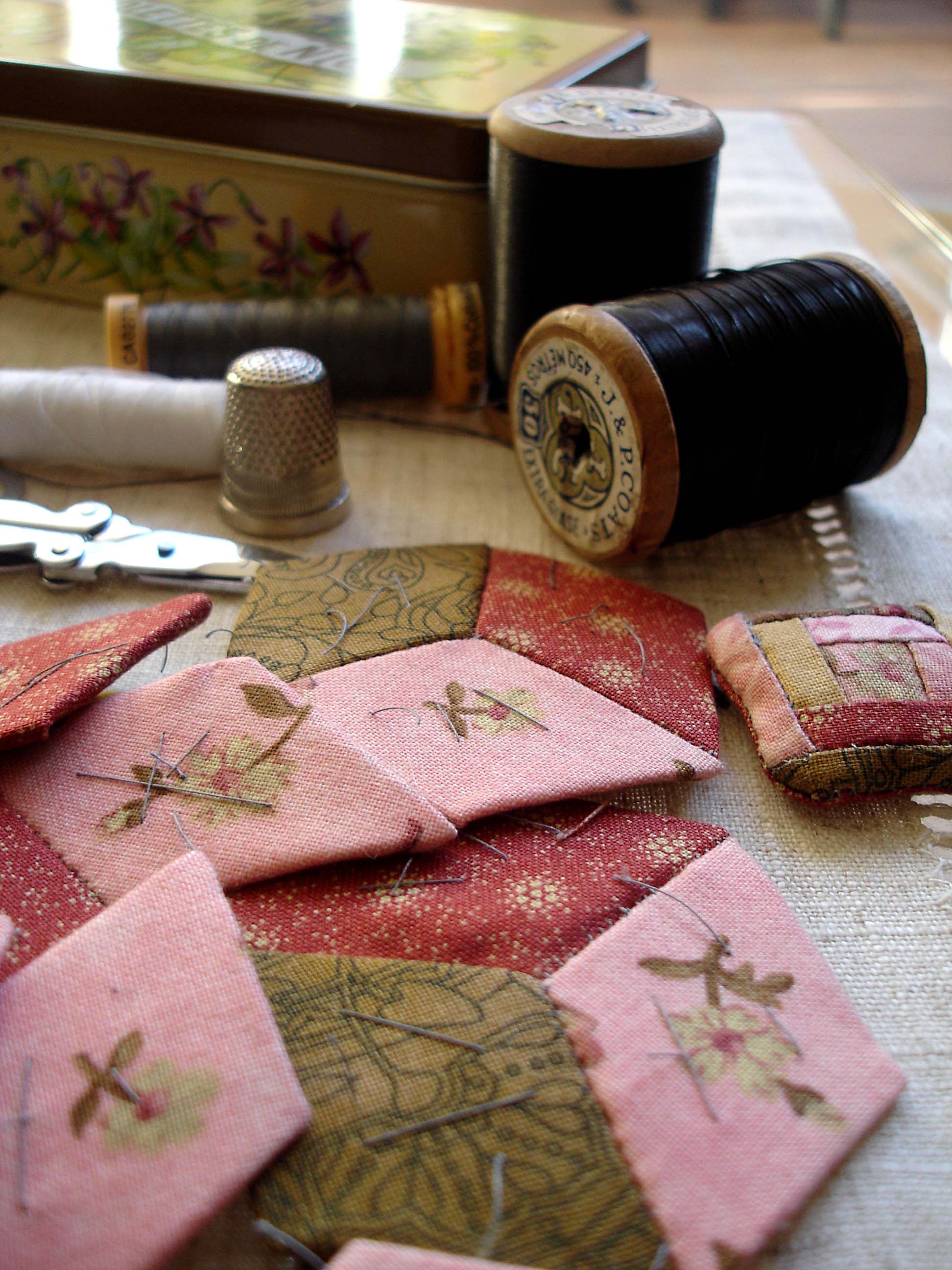
Photo: Anna, CC BY 2.0.
The pieces were still separate. Pink hexagons, red ones, a brown print with a small flower, each shape stuck to the next with a straight pin. A metal thimble sat in the glare. Snips lay open. The big spool in front is dark thread on a wooden core, and the label reads J. & P. Coats. A floral tin sits behind them.
Patchwork is pieces of cloth sewn into a larger design, usually from simple shapes that can be measured and joined. That firm of thread traces its start to 1755. The spool on this table is the ordinary one, the kind that lived in a tin with a floral lid and came out for every project that was meant to be used.
She did not start with a bed. She started with a shape she could hold. The dog got the result much later, once the pins were gone.
#17 Two women tying a quilt in New Ulm

Photo: Flip Schulke, public domain.
One woman wears red and a small white pin. The other wears a checkered shirt and glasses, and her hand is already on the next square. The top is a tumble of prints: dots, flowers, a green patch, a blue triangle. Pale blue yarn is tied at the corners. This is New Ulm, Minnesota, and the work is happening at a table, not on a show stand.
Quilting joins at least three layers, a top, a batting, and a backing. Stitches can do that job. So can yarn. Tying fastens those layers with yarn or with several strands of thread, mostly on quilts that are meant to be used and needed soon. A tied quilt is a working quilt. His bed was a working place.
Leave the fancy stitch for the guest room. The one with the yarn knots can go on the floor tonight.
Did you know?
Tying is the quick join. Yarn, or several strands of thread, holds the three layers when a quilt is meant to be used and needed soon. Families used that speed when a bed, or a dog, could not wait for a show quilt.
Source: the quilting note on tying layers with yarn
#16 A green patchwork quilt, sewn by hand

Photo: jude, CC BY 2.0.
Every green in the rag bag seems to have made the cut. Sage, teal, a print of leaves, a square with a pink flower left in the middle of the calm. A band of white lace crosses the upper part like a hem somebody refused to throw away. The right edge is a darker tree print. The stitches pucker the cloth, which is how a hand-sewn top tells on itself.
A quilt is that layered cloth: commonly a woven top, a filler, and a woven back, held together by the stitching. The green one is already a blanket. In a lot of houses the newest quilt stayed on the bed, and the older one, still warm, moved to the floor where he turned around three times and sighed.
Wash it when it smells like him. That is not a failure. That is the job it grew into.
#15 Two small dogs in striped knitted sweaters

Photo: Sciencia58, CC0.
Grass, two leashes, and sweaters that clearly came off somebody’s needles. The white dog wears pink, lilac, and a pale band, with a pink collar under the ribbing. The tan dog in front wears blue, white, and teal, and the rib at the hem is the same blue as the leash clip. Ears are out. Tails are out. The sweaters stop where the legs need to move.
In American English the garment is a coat. A coat for a dog is a covering people make to protect a pet from the weather. The stripes in this picture are hand knitting, row after row, the kind of afternoon project that ends with a walk instead of a folded square in a drawer.
Measure him while he is standing, not while he is hoping for a biscuit. A sweater that binds the shoulder is a sweater he will back out of.
#14 A knitted dog sweater, laid flat

Photo: Sciencia58, CC0.
Off the dog, the shape is honest. A teal rib at one end, bands of blue and white, two openings edged in dark blue for the legs, and a neck opening the same color. A separate knitted tube, blue and white, lies to the right. The cloth under it is printed with stars. Nothing about it looks like a store poly bag. The stitches are big enough to see.
Knitting interloops a continuous yarn into rows of loops. By hand, a pair of needles makes those loops one at a time. A dog sweater is a small map of that idea: a tube for the chest, holes where the legs insist on existing, and a rib so the hem stays put when he shakes.
Keep the leg holes generous. He will forgive a color you are tired of. He will not forgive a tight armhole.
#13 Knitting needles still in the work

Photo: Shisma, CC BY 4.0.
The work is not done, and the needles say so. Two metal tips cross in a charcoal knit, loops still sitting on the shafts, fuzz of gray yarn caught in the light. This is the stage that lived on the arm of the couch. If the phone rang, the needles stayed in. If he jumped up, somebody said his name in the warning voice.
Hand knitting uses those needles so each loop is made singly, rather than a machine forming a whole row at once. The dark piece in the photograph is simply cloth in the middle of becoming something. A scarf, a square, the start of his next sweater. The house could tell which, because the project never really left the room.
Slide the needles to the end of the row before you stand up. A dropped loop is a small grief, and he cannot fix it.
#12 A thick red knitted scarf on a blue chair

Photo: snickclunk, CC BY 2.0.
The chair is pale blue. The knit is a heavy red, ribs deep enough to hold a shadow, folded so the edge rolls. It looks warm before anybody touches it. A scarf this thick spent the cold months on a small dog, or on the back of his chair, which in some houses was the same chair.
Brioche knitting is a family of stitches that tuck one loop with another, often a yarn over paired with a slipped stitch, so the cloth grows a soft second layer. The red piece has that plump hand-knit body. Women made it when a plain rib felt too thin for a January kitchen and a short-haired dog. Set on the blue chair, the red knit holds a fold instead of going flat. A short dog can wear it once.
One wrap around the neck is plenty. He still has to see the food bowl.
You might also like: 23 Things Our Dogs Did in the 1970s That Would Shock Owners Today
#11 A bright knitted blanket and a basket of yarn

Photo: Whiteghost.ink, CC BY-SA 4.0.
Black lines fence off the colors: pink, purple, blue, green, yellow, orange, a red block near the hem. The knit is plain and even, the kind of stitch a person can do while the news is on. Above it, a basket holds balls of the same bright yarn, labels still on a few. Bookshelves fill the room behind the cart. This is a blanket with the supplies still in the picture.
An afghan is a blanket or shawl, usually knitted or crocheted, sometimes just called a throw. By 1860 the word, used as a noun, meant that kind of handmade piece at state fairs, shown beside patchwork. American living rooms kept the habit. The bright one ended up on the couch, and then, inevitably, under him. The basket still holds the leftovers.
Choose colors you can stand at 6 a.m. He will lie on it every morning you own it.
Did you know?
The handmade blanket had a fairground life before it had a brand. In 1860, show lists were already using “afghan” for a knitted or crocheted piece entered next to patchwork quilts. The couch came later. The dog came right after the couch.
Source: the history of the afghan as a state-fair handicraft
#10 A zigzag crocheted blanket, still unfinished

Photo: Cary Bass, CC BY-SA 3.0.
Black and yellow, row after chevron, thrown over the side of a wooden bed. A single pale strand drops toward the rug. The top edge is still a little curly, which is what happens when the last row has not been decided yet. It is large enough for a person and therefore large enough for him, which is why these projects changed owners.
Crochet builds cloth with one hook, pulling loops of yarn through other loops. The word comes from the French for hook. A zigzag this wide is an evening habit, not a single sitting. He supervised from the mattress, which slowed the hook and improved his afternoon. The loose strand in the picture is still looking for the ball it came from. Those chevrons took more than one evening.
Finish the edge before you call it his. A loose loop is an invitation he understands too well.
#9 A crocheted blanket with a scalloped edge

Photo: 999real, CC0.
Squares with a flower in the middle: purple, mint, pink, each one framed in cream and joined with green. The edge is a white scallop, plump and a little ruffled. You can see every stitch. This is the blanket that looked too pretty for the floor and went there anyway, because he had already tested it.
A granny square is a crocheted square worked in rounds from the center out. Makers usually work small squares and join them into a blanket, a wrap, or a cover. They are handmade. A machine does not turn them out. The flowers in this photograph are that kind of joined square, with a scallop added once the field was big enough. The scallop was the last row.
Put it where he already sleeps. A blanket stored in a chest is only a blanket. On the rug, it is his.
Did you know?
Those flowered squares are a hand craft all the way through. A granny square is crocheted from the middle outward, and the traditional ones are not a machine product. Women joined a pile of them on the kitchen table until the pile became a cover.
Source: the description of granny squares as handmade motifs
#8 A pale crocheted square with a green border

Photo: Durova, CC BY-SA 3.0.
It is one square, not a heap. The center is a pale open stitch, almost a net, so the black behind it shows through. A light green border frames it, and each corner carries a small round motif. The size is modest. Spread on a chair, it covers a seat. Spread on the floor, it covers one dog, if the dog is polite about elbows.
Crochet uses a single hook to lock loops of yarn or thread. A square like this was often the first finished thing, before anybody promised a full blanket. Small dogs inherited those first squares. The open stitch breathes, which mattered in a house that kept the heat low and the dog indoors. A summer floor shows through it.
If he is tiny, this is the whole bed. If he is not, it is the pillow at the end of a bigger one.
#7 A wooden hoop of stitched flowers

Photo: Rbreidbrown, CC BY-SA 4.0.
A hand holds the hoop at the bottom. Inside the wood ring: a large pink flower with a gold center, smaller red buds, olive leaves, and a few gray-blue sprigs. The cloth is white and still a little wrinkled at the top, where it is caught in the screw clamp. A turquoise dresser sits out of focus behind it. This is lap work. The hoop kept the fabric tight so the stitches stayed even.
Embroidery is the art of decorating fabric or other material by stitching thread or yarn with a needle. The flowers in the hoop are that decoration. The same hoop held a name, a paw print, or a plain initial on the cloth that became his cushion. The dog was the reason the project got finished.
Stitch his name where a washer will not eat it. The flower can stay on the wall.
#6 A leather collar with pale green stitching

Photo: Trougnouf (Benoit Brummer) and Les cuirs d’Agathe, CC BY 4.0.
The collar is black on the outside and green on the inside, and the stitch that joins them is a pale green line you can follow all the way around. Brass buckle, brass ring, a row of holes. It sits on a light wood table, curled the way a collar curls when it has already learned a neck. The stitch is the handmade evidence. Hardware can be bought. That even line of thread was somebody’s hour.
A dog collar is the band around the neck, used for restraint, identification, or simply for looks. Tags and medical notes are often carried there. A stitched leather collar can be beautiful and still do the plain job. The green thread is the part you notice when you clip the leash.
Fit two fingers under it and then stop fussing. A handsome collar that slips off is only a bracelet.
You might also like: 20 Things Families Kept by the Back Door for the Dog in the 1980s
#5 A plaid bow on a collar

Photo: Mcbzen, CC BY-SA 4.0.
Navy, pink, and white checks, tied into a bow that is wider than the collar it rides on. The strap matches. A silver buckle and a round ring sit at the right. In a real hall it looked like Saturday. Somebody ironed that cloth. Somebody stitched the knot so it would not collapse before church, or before the picture, or before the walk that was supposed to be quick.
Collars also get worn for fashion, which is the bow’s whole career. Identification still belongs on the band itself, where a tag can be read. The plaid is the greeting. It does not carry a phone number, and it was never asked to. Women made the bow because a plain strap felt unfinished on a dog they were proud of.
Sew the bow so it can come off. Bath day is not a day for plaid.
#4 Braided rag rugs, and one still in her hands

Photo: Jasper L. Crawford, public domain.
She stands under a canvas tent in a light blouse and plaid pants, holding a braid that runs longer than she is tall. Behind her, oval rugs hang in loops, each one a coil of cloth strips. The cliff of Zion National Park rises past the trees. This is a demonstration, which means the rugs were the point, not the backdrop.
A rag rug is made from rags. Strips of used cloth are braided and coiled into a mat, or hooked through a burlap backing. In the United States, hooking pulled a thin strip up into a small loop pile. Braiding was the other household way, and it used the clothes that had already done their first job. His corner of the kitchen got the oval that had gone soft.
Shake it outside. The grit is the story of the week, and the braid can take it.
#3 A green braided rope toy

Photo: Rhododendrites, CC BY-SA 4.0.
He is low on a green carpet, ears up, with the toy already in his mouth. The braid is green and white, knotted, with a tassel of green and a tassel of dark blue. One paw is over the near end, which is how a small dog explains ownership. The rope is the whole toy. No squeaker, no plastic face, just cord that can be washed and will still look like itself.
The braid is the same family of work as the rag rug, only short enough to shake. Women twisted cotton cord, clothesline, or torn strips until the strands locked. Three strands, pulled tight, make a tug that survives a rainy afternoon in the living room. The one in the photograph has the tassel they always added, because an end without a knot comes apart.
Retire it when the strands open. Until then, it can live by the couch.
#2 A sock monkey in a red hat and a yellow scarf

Photo: Kim Scarborough, CC BY-SA 2.0.
He sits on a beige carpet against a radiator. Brown sock body, white hands and feet, a wide red mouth, purple buttons for eyes. A yellow knitted scarf hangs to his middle, and a red hat carries a small gold atom and a gold tassel. Somebody made every one of those parts. The scarf is a second project.
The red mouth has a hometown. John Nelson, a Swedish immigrant, was knitting socks by machine in Rockford, Illinois, as early as 1870, and the Nelson Knitting Company formed there in 1880. In 1932 the company put a red heel on its brown sock. That heel, once the sock was stuffed and stitched, became the mouth of the monkey people still recognize. This one has the red mouth.
If the dog adopts him, check the buttons now and then. A toy that survives the wash has earned the couch.
Did you know?
The red heel was a 1932 idea from Rockford, Illinois. Nelson Knitting added it to a brown sock, and home stitchers turned that heel into a monkey’s mouth. The yellow scarf in the photograph is extra. The red mouth is the old signature.
Source: the Rockford history of the red-heel sock monkey
#1 A stuffed horse sewn from printed cloth

Photo: GAlexandrova, CC BY-SA 4.0.
Brown cloth printed with small stars, stuffed until the horse can stand. The mane and tail are yarn, silver-white and a little wild. A yellow ribbon makes a halter. Red plaid bands wrap the chest and the ankles, and a yellow strap runs under the belly to a metal ring. Large pale buttons mark the shoulders. He stands on a lace cloth. Every edge is a seam somebody turned and stitched.
This is the scrap toy at the end of the rag bag. Patchwork thinking, cut smaller: printed cloth, a ribbon from a parcel, yarn that was too short for a row. Women sewed animals like this for children, and the family dog received joint custody by the end of the week. The yarn mane is the part a washer will test.
Stitch the openings twice. He loves a toy most on the day the stuffing tries to leave.
The bottom line
The handmade pile was never one grand gift. It was hexagons and a spool, a tied quilt in a Minnesota room, a green top with lace in it, striped sweaters, a sweater waiting flat, needles still in the row, a red scarf, a bright knitted blanket, a zigzag not yet ended, a scalloped crochet cover, a small pale square, a hoop of flowers, a stitched leather collar, a plaid bow, braided rugs, a rope toy, a sock monkey, and a horse made of starry cloth. Keep the ones he actually uses. A tag on the collar, a blanket that can be washed, a toy with the seams still shut. The rest is the pleasure of having made it. None of it had to be perfect. It had to be finished, and then it had to be his.
Bonus: What still belongs in the sewing basket
- A sweater that clears his shoulders and lets the legs move.
- A blanket with an edge that is actually finished.
- A collar that can hold a tag, whether or not it also wears a bow.
- A stuffed toy with the opening sewn twice.
- A braid, rug or rope, that can be shaken outside.
Questions people also ask
What is a quilt, in plain words?
It is layered cloth. The usual three parts are a top, a batting in the middle, and a backing. Quilting is the work of joining those layers, either with stitches through all of them or, on a quilt meant for daily use, with ties of yarn. The green hand-sewn top and the tied patchwork in New Ulm are both in that family. His bed did not require the show version. A tied quilt can go into use the day the knots are done.
Why did a handmade sweater go on the dog?
In the United States the garment is called a coat, and a coat is something people make to protect a pet from the weather. The striped sweaters on the grass, and the teal one laid flat, are small knitted versions of that idea. Hand knitting builds them one loop at a time, with openings left for the legs. If the rib binds, he will refuse it, which is useful criticism. The grass in that picture is the test: if he can still walk, the sweater fits.
Does the bow tie count as identification?
No. A collar can be for looks, and the plaid bow is looks. Tags and medical information ride on the collar itself, where a person can read them. Fashion is a separate job from identification. Sew the bow so it can be removed on bath day. Leave the tag where it was.
What is a granny square?
It is a crocheted square made in rounds that start at the center. People usually make a stack of small ones and join them into a blanket. They are a hand craft, worked from the middle outward, and a machine does not turn them out. The scalloped cover with the flowered squares is that kind of joining, with an edge added at the end.
Where did the sock monkey’s red mouth come from?
Rockford, Illinois. John Nelson was machine-knitting socks there by 1870, and the Nelson Knitting Company formed in 1880. In 1932 the firm added a red heel to its brown sock, and stitchers at home turned that heel into a monkey’s mouth. The monkey in the photograph also has a yellow scarf and a red hat. The red mouth is the part with the Rockford history. The scarf and the hat were the stitcher’s own additions, done at the kitchen table.
This article is household history, not a sewing pattern and not a substitute for your own veterinarian.
Keep reading
26 Things Every Family Dog Had in the 1960s That Nobody Buys Anymore
More you’ll enjoy
- 20 Family Pet Keepsakes Your Children Will Probably Throw Away
- 18 Pet Habits from the 1950s Vets Now Beg Owners to Stop
- 25 Dog Breeds Every Neighborhood Had in the 1960s
Explore more

- 18 Things Women Made by Hand for the Family Dog - November 24, 2026
- 14 Things You Never Knew About the Dalmatian on the Fire Truck - November 24, 2026
- Do Hamsters Hibernate? Winter Torpor Guide for Hamster Owners - November 23, 2026
GIPHY App Key not set. Please check settings