

 Lauryn Dell
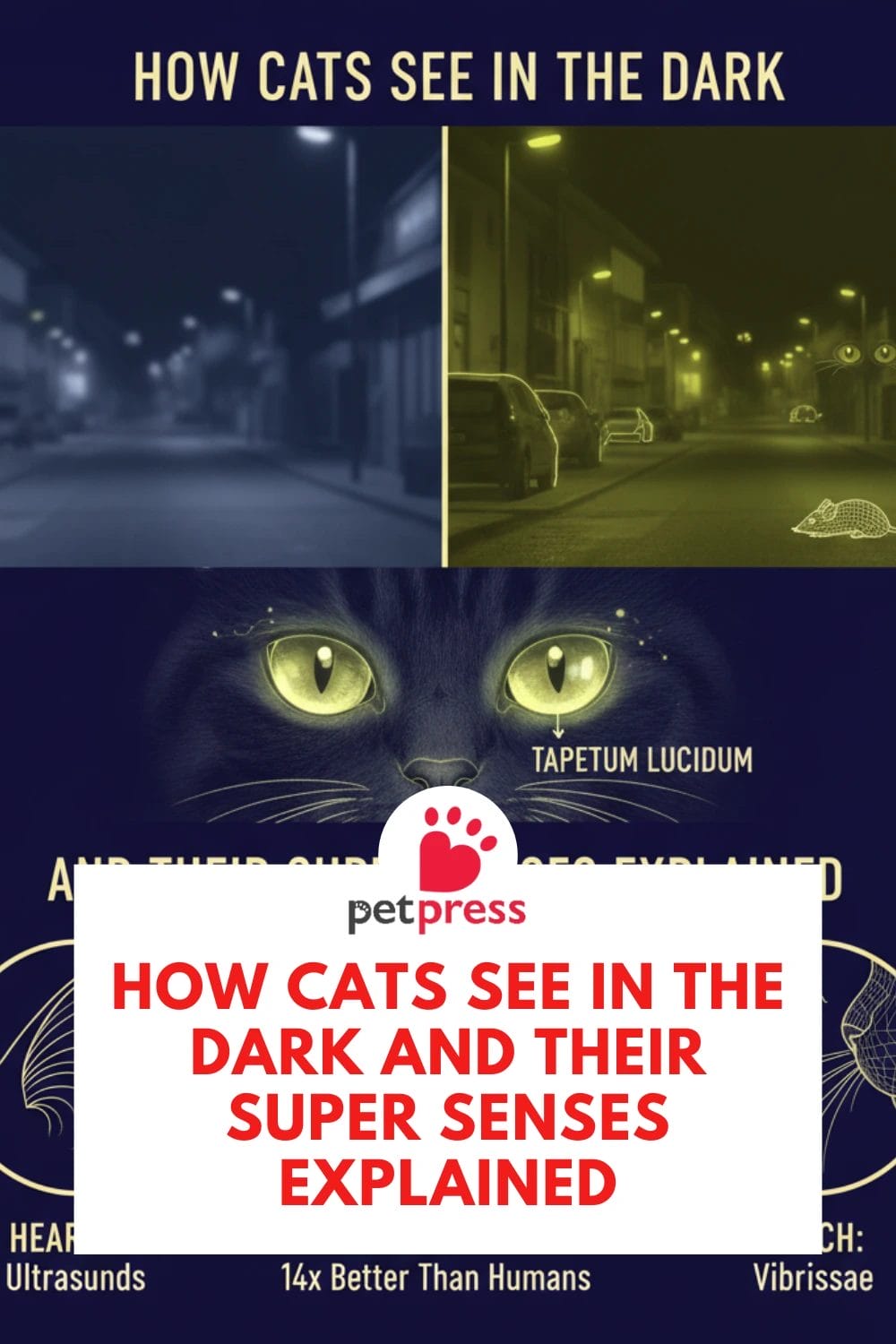
Cats have fascinated humans for thousands of years, not only for their elegance and companionship but also for their remarkable abilities that appear almost supernatural.
One of the most intriguing traits of cats is their ability to see and thrive in low-light conditions.
Whether it’s prowling through the shadows of your living room or navigating a moonlit garden, cats demonstrate sensory powers that go far beyond human capacity.
But their night vision is only part of the story. Cats are biological masterpieces equipped with enhanced vision, acute hearing, and an incredible sense of smell, all designed by evolution to make them stealthy, efficient predators.
This article dives deep into the biology behind How Cats See in the Dark super senses, focusing primarily on their night vision, while exploring the other sensory advantages that make them true masters of their environment.
The Science of Night Vision in Cats
Specialized Eye Anatomy
Cats’ eyes are built differently from human eyes, optimized for survival in dim environments. Their pupils can dilate far wider than ours, allowing maximum light intake.
In addition, cats’ corneas and lenses are proportionally larger, capturing more light and focusing it directly onto the retina.
This design enables them to detect movements and shapes that would be invisible to humans in the same environment. It’s one of the key reasons cats appear so graceful in darkness—they can actually see far more than we imagine.

The Role of Rods and Cones
The retina of the eye contains two main types of photoreceptor cells: rods and cones. Humans rely on cones for color vision and rods for detecting light intensity. Cats, however, have a much higher ratio of rods to cones.
- Rods: Cats’ retinas are rod-dense, making them six to eight times more sensitive to low light than humans. This enables them to detect even the faintest glimmers of movement in near darkness.
- Cones: While cats do have cones of their own, they are not as numerous or as varied as in human eyes. This means cats have limited color vision, seeing the world primarily in muted tones of blue and green.
The Tapetum Lucidum: Nature’s Reflector
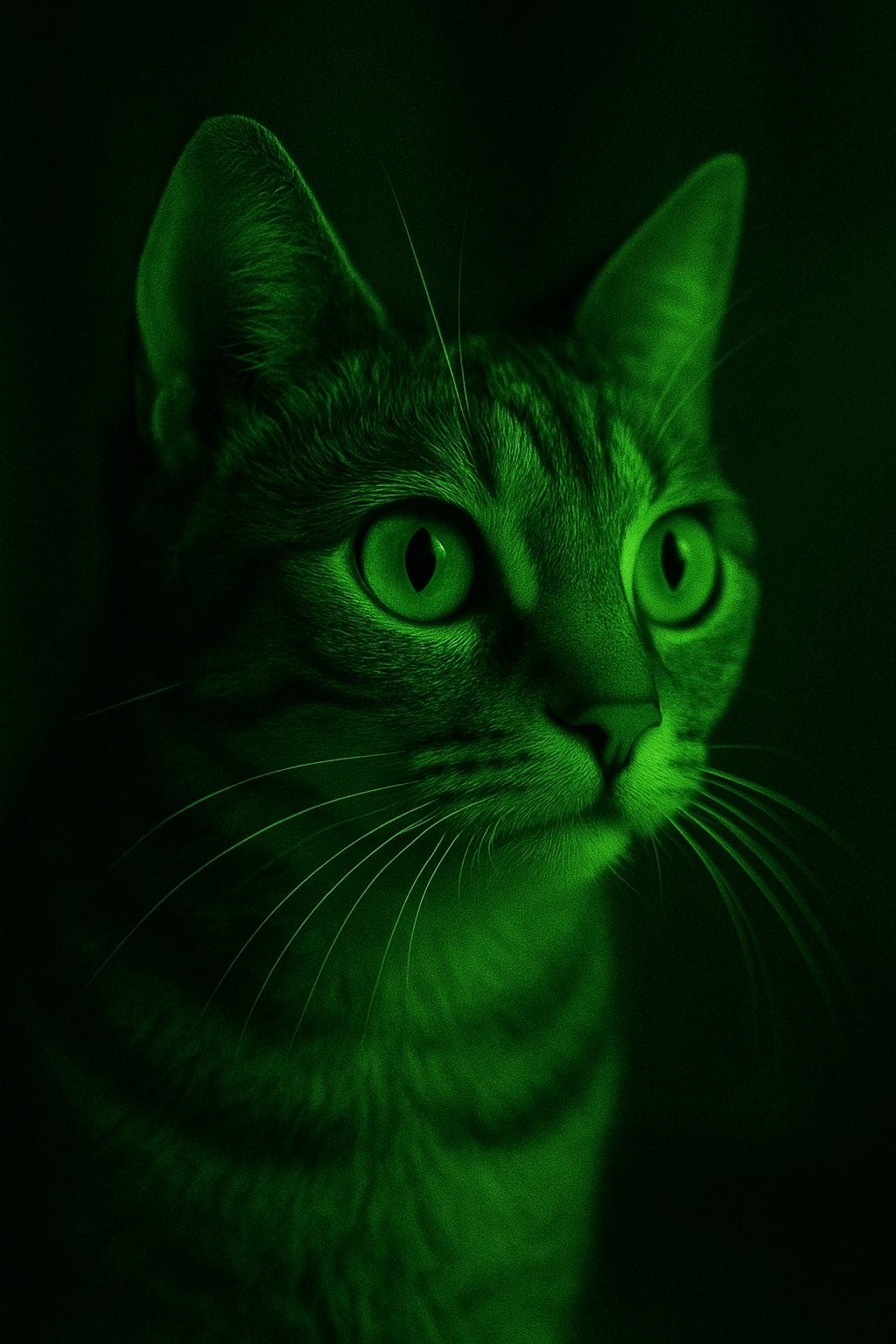
One of the most striking features of feline eyes is the tapetum lucidum, a reflective layer behind the retina. This biological mirror bounces light back through the retina, giving the photoreceptors a second chance to absorb it.
This amplifies night vision and causes cats’ eyes to glow in the dark when exposed to light, a phenomenon often mistaken as spooky but actually a survival adaptation.
Beyond Vision: How Cats See in the Dark
Extraordinary Hearing Abilities
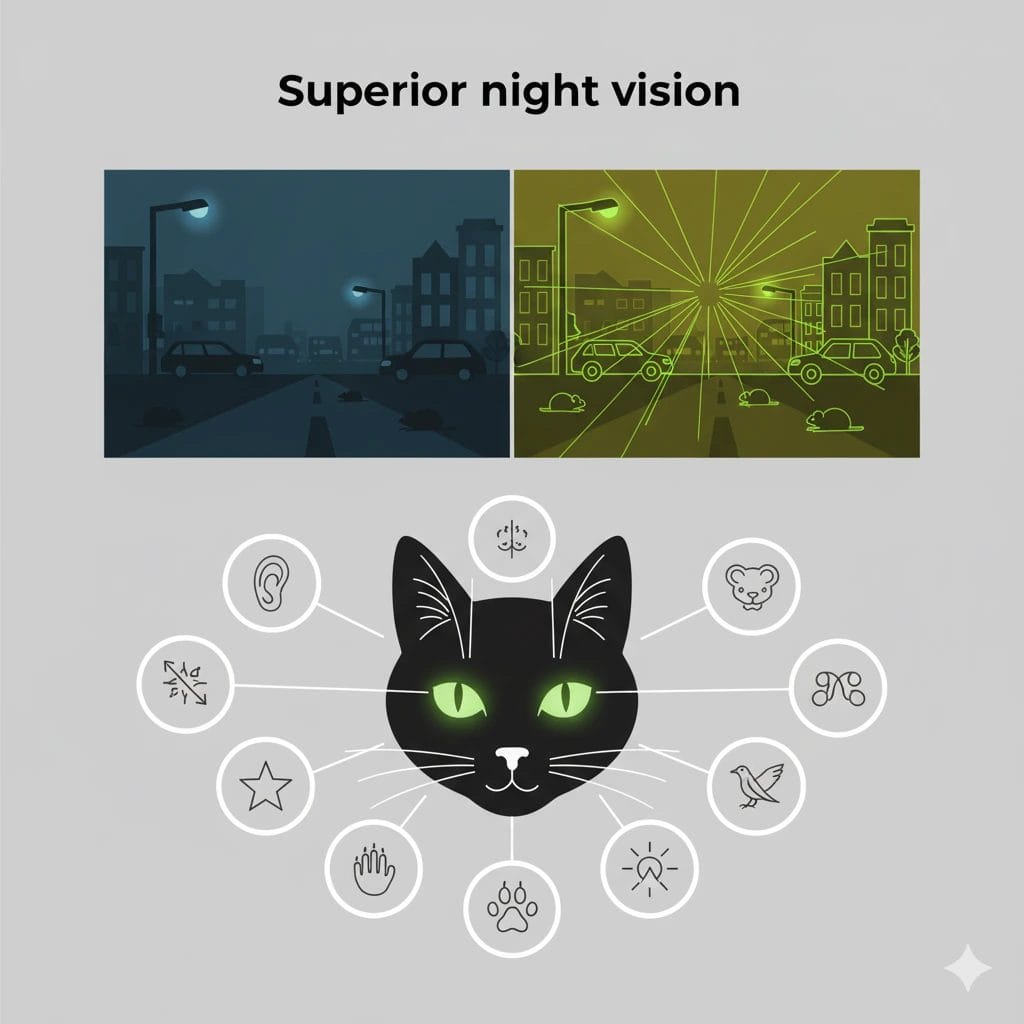
Cats are born hunters, and their hearing capabilities are a vital part of their arsenal. A cat’s ear is designed with more than 30 muscles, allowing it to rotate independently in almost any direction.
- Frequency Range: Cats can detect frequencies between 48 Hz and 85 kHz, surpassing both humans and dogs. This means they can hear ultrasonic sounds produced by rodents, helping them locate prey in total darkness.
- Directional Precision: Their acute hearing allows them to pinpoint the exact location of sound sources. This directional hearing is so advanced that cats can locate a sound’s origin within a margin of just a few inches.
The Power of Smell
Though not as celebrated as their vision and hearing, cats’ sense of smell is remarkably strong. Their nasal cavity houses approximately 200 million odor-sensitive cells, compared to about 5 million in humans.
- Communication: Cats use scent to communicate with each other and their environment. They mark territory with pheromones and rely on smell to identify familiar individuals and detect changes in their surroundings.
- Hunting Aid: When combined with their vision and hearing, smell allows cats to track prey, recognize food, and detect potential dangers in their environment.
Whiskers: The Sixth Sense
Whiskers, or vibrissae, provide cats with tactile sensory input that is just as vital as sight or sound. These highly sensitive hairs detect changes in air currents, allowing cats to sense nearby objects without physically touching them. This makes whiskers especially useful in navigating tight or dark spaces.
Evolutionary Advantage of Super Senses
The development of cats’ sensory systems is deeply rooted in their evolutionary history. Cats evolved as crepuscular hunters, most active during dawn and dusk, times when lighting is dim and prey is vulnerable.
Their superior night vision, acute hearing, and sharp sense of smell gave them a survival edge, allowing them to secure food efficiently while avoiding predators.
Even though domestic cats no longer rely on hunting for survival, these evolutionary adaptations remain intact.
This is why your pet cat may suddenly dart across the room, chase after invisible prey, or remain fixated on a corner where you perceive nothing; its heightened senses are picking up signals you cannot detect.
Modern Applications: Understanding Cats for Better Care
Recognizing the biology behind cats’ senses isn’t just fascinating; it has practical implications for how humans interact with and care for their feline companions.
- Home Environment: Cats thrive in spaces where their senses are engaged. Providing toys that stimulate their hearing or scent-based enrichment items can help keep them active and content.
- Veterinary Insights: Understanding sensory biology assists veterinarians in diagnosing issues such as vision loss, hearing impairments, or stress-related behaviors.
- Training and Bonding: Knowledge of cats’ sensory world can help owners communicate more effectively, using sounds, scents, and environmental cues to strengthen the human-animal bond.
Conclusion: How Cats See in the Dark
Cats are not just domesticated companions; they are highly adapted predators designed by evolution to navigate a world of shadows, subtle sounds, and faint scents.
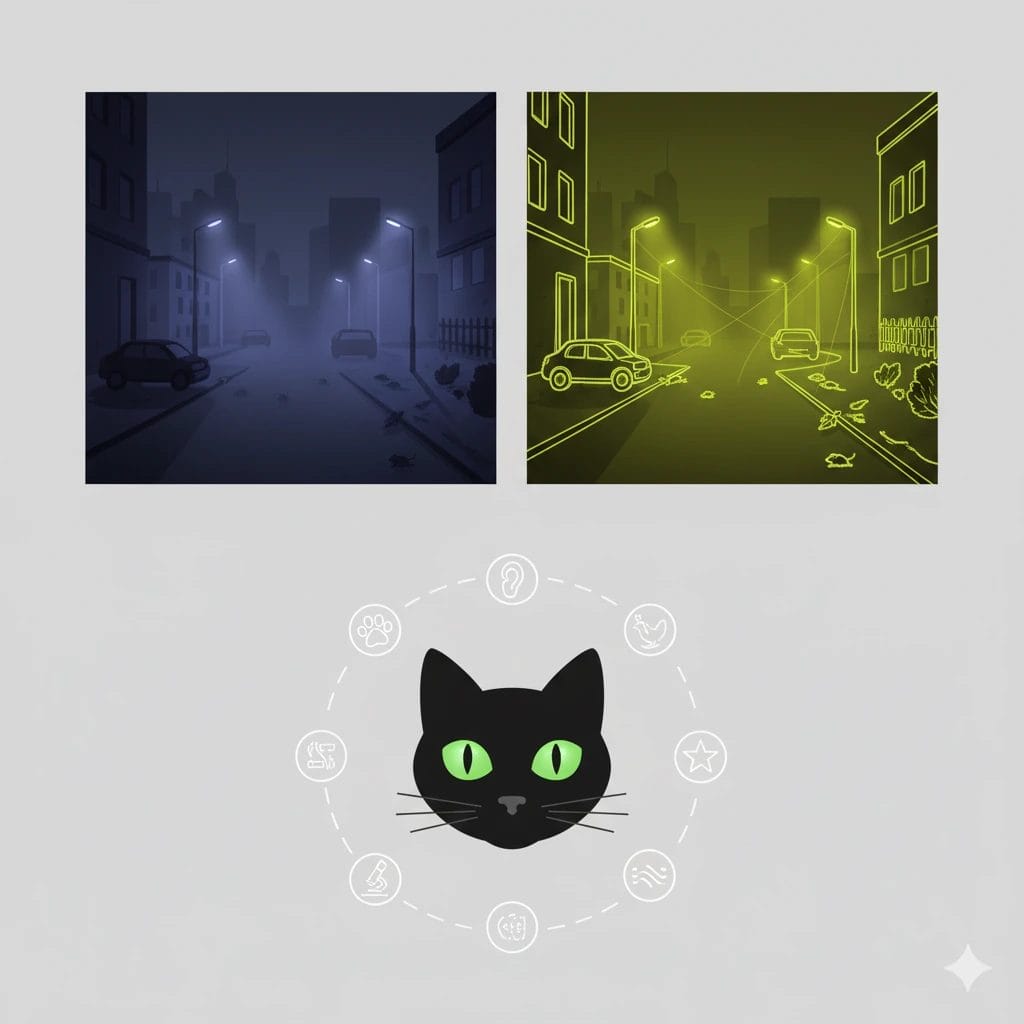
Their night vision, enhanced by specialized eyes and reflective tapetum lucidum, allows them to see where humans cannot.
Cats have super senses, complemented by extraordinary hearing, a keen sense of smell, and sensitive whiskers, which make them true masters of their environment.
We can better understand and appreciate the biology behind How Cats See in the Dark. Also, cat owners can better connect with their pets and create enriching environments that honor their natural instincts.
Cats remind us daily of the marvels of evolution and the extraordinary power of sensory perception.
FAQs
No, cats cannot see in absolute darkness. However, their eyes are so sensitive to low light that they can function effectively in conditions where humans would be nearly blind.
Cats have limited color vision. They can see shades of blue and green but struggle to distinguish reds and other warm tones. Their vision is optimized for movement detection and low-light conditions rather than vibrant colors.
The glow comes from the tapetum lucidum, a reflective layer behind the retina that amplifies light. This adaptation enhances their night vision and produces the glowing effect when exposed to light.
Cats can hear frequencies up to 85 kHz, while humans typically hear only up to 20 kHz. This allows them to detect ultrasonic sounds produced by small prey like rodents.
Whiskers are highly sensitive tactile tools that detect air movement and vibrations. They help cats navigate in the dark, judge spaces, and sense nearby objects without touching them.

- 15 Meaningful Dog Memorial Tattoo Ideas & Costs - March 20, 2026
- Best Horse Hoof Supplement Reviews for Beginners (2026) - March 19, 2026
- Pet Rat Hammock Setup Guide: Best Layouts & Prices - March 19, 2026
GIPHY App Key not set. Please check settings