

 Emily Walker
Africa is packed with incredible wildlife, but some of the most dangerous animals are the ones you may never spot until it is too late.
Most people think first about lions or elephants, but venomous snakes cause a huge number of deaths every year.
Reptiles Magazine says more than 32,000 people die from snakebites in Africa each year, and experts think that number may still be too low.
If you love wildlife, plan to travel in Africa, or just want to stay smart, learning about these snakes matters.
This guide looks at some of the continent’s most dangerous species — like the super-fast black mamba and the sneaky puff adder — and explains where they live, how they behave, what their venom does, and what to do if you ever cross paths with one.
Quick Facts: Snakebites in Africa
- About 91,000–420,000 snakebite envenomations happen in sub-Saharan Africa each year.
- More than 20,000 confirmed deaths happen every year in sub-Saharan Africa alone.
- The real number may be as high as 50,000 a year, because many cases are never reported.
- In 2017, the WHO classified snakebite as a top-priority neglected tropical disease.
- Only about 16% of snakebite victims in rural Africa get treatment at health centers.
Understanding Snake Venom: The Two Main Types
Before we jump into specific snakes, you need to know something important: snake venom is not all the same.
Think of it like different “attack styles” — and the effects on the body can be totally different.
Neurotoxic Venom
This one goes straight for your nervous system, basically scrambling the “wiring” in your body. It can lead to paralysis and, in the worst cases, stop you from breathing.
You see this in snakes like mambas and most cobras. What makes it extra scary is the delay — a person might feel okay at first, then suddenly things go downhill fast, like a switch being flipped.
Hemotoxic (Cytotoxic) Venom
This type is more like slow destruction. It attacks blood cells and tissue, messing up clotting and causing extreme swelling and damage.
Vipers like the puff adder and Gaboon viper use this kind. Survivors often still face serious injuries, and in some cases, tissue damage can be so severe it leads to loss of a limb.
Africa’s Most Venomous Snakes: Species Profiles
Let’s talk about the “big names” — the snakes people across Africa respect (and honestly, fear). But here’s the twist: most of them don’t want trouble. Trouble just sometimes finds them first.
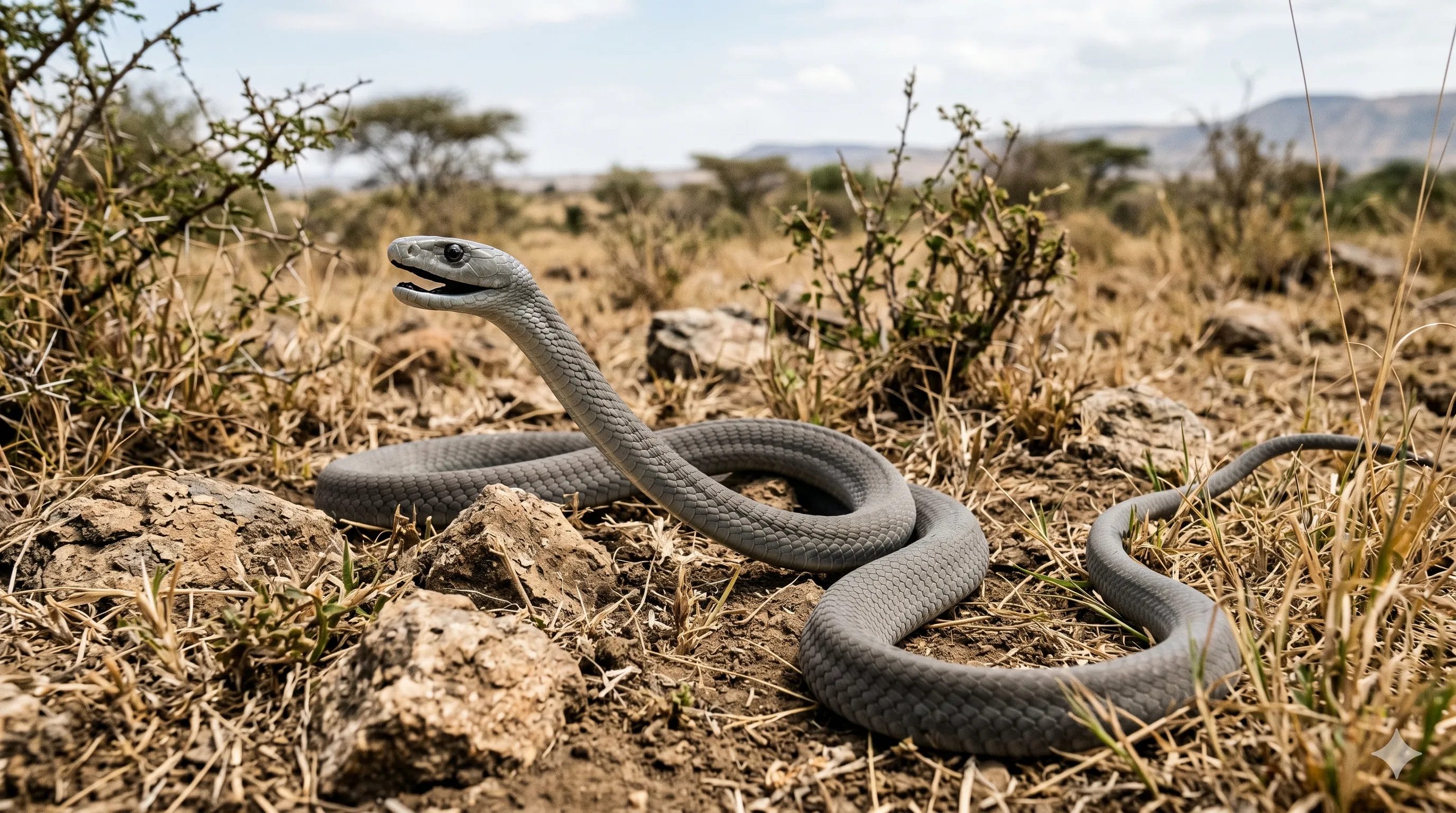
1. Black Mamba (Dendroaspis polylepis) — Africa’s Deadliest Snake
This is the snake that shows up in legends, movies, and campfire warnings. The black mamba has a reputation like a villain in a story — fast, precise, and incredibly dangerous — but the truth is a bit more nuanced.
Key Facts:
- Africa’s longest venomous snake, reaching up to 14 feet (4.3 m)
- One of the fastest snakes on Earth, hitting about 12.5 mph (20 km/h)
- Named for its black mouth, not its body (which is usually olive or gray)
- Its venom attacks nerves and the heart; without treatment, it can be deadly very quickly
- In serious bites, death can happen in under 30 minutes
- Lives across sub-Saharan Africa in open land and rocky areas
Here’s the part most people miss: it’s actually shy. It would rather disappear into the bushes than face you. But if it’s trapped, it can strike repeatedly — not out of rage, but panic.
2. Puff Adder (Bitis arietans) — Africa’s Deadliest Biter
This one is the “stealth danger.” If the black mamba is a sprinter, the puff adder is a master of hiding in plain sight.
Key Facts:
- Responsible for more human deaths than any other African snake
- Blends perfectly into dirt paths and grass — people often step on it by accident
- Its venom destroys tissue and causes extreme swelling and damage
- Found across most of Africa (almost everywhere except deserts and rainforests)
It doesn’t chase people. It just lies there… and that’s exactly why it’s so dangerous.
3. Gaboon Viper (Bitis gabonica) — Longest Fangs in the World
This snake looks like something out of a fantasy game — huge fangs, massive venom supply, and camouflage so good it basically becomes part of the forest floor.
Key Facts:
- Has the longest fangs of any snake (up to 2 inches / 5 cm)
- Produces an enormous amount of venom per bite
- Venom is highly destructive to tissue
- Surprisingly calm and slow-moving
- Most bites happen when someone accidentally steps on it
4. Saw-Scaled Viper (Echis spp.) — The World’s Most Prolific Killer
This is the “small but terrifying” snake. You could literally step over it without noticing… and that’s the problem. It’s responsible for a huge number of snakebite deaths in Africa and beyond, especially in dry, rural areas where hospitals are far away.
Key Facts:
- One of the deadliest snakes in terms of total human deaths worldwide
- Causes most snakebites in parts of northern and western Africa
- Makes a scratchy “sizzling” warning sound by rubbing its scales together
- Its venom attacks blood clotting and is extremely potent for its size
- Most bites happen at night when people can’t see it
It’s basically a tiny desert ambush expert — fast, defensive, and often encountered by accident.
5. Cape Cobra (Naja nivea) — Africa’s Most Venomous Cobra
Don’t let the word “cobra” fool you into thinking they’re all the same. The Cape cobra is one of the most dangerous of them all, especially because of how fast its venom works.
Key Facts:
- The most venomous cobra in Africa
- Venom can cause death in just a few hours without treatment
- Strong neurotoxic effects that shut down breathing
- Found mainly in southern Africa, in many different colors (yellow to dark brown)
It’s a snake that doesn’t give you much time to react — when things go wrong, they go wrong fast.
6. Boomslang (Dispholidus typus) — Drop for Drop, the Most Toxic Venom in Africa
This one is sneaky in a different way. It lives in trees, blends in perfectly, and has a dangerous habit of making people think they’re safe… until it’s too late.
Key Facts:
- One of the most toxic venoms in Africa, drop for drop
- Causes severe internal and external bleeding
- Symptoms can take hours or even days to show up
- Tree-dwelling snake with huge eyes and green or brown coloring
- Bites are rare, but very serious when they happen
It’s like a “delayed warning system” that unfortunately doesn’t warn you in time.
7. Egyptian Cobra (Naja haje) — The Snake of Legends
This is the snake of history books and ancient stories — the one people whisper about in tales of kings and queens. But it’s not just legend; it’s a real and dangerous animal.
Key Facts:
- Large cobra found across northern and parts of sub-Saharan Africa
- Venom affects both nerves and tissue
- Can cause death within hours if untreated
- One of the most iconic snakes in African history and mythology
It’s the kind of snake that carries both fear and fascination — respected for thousands of years, and still very much dangerous today.
The Antivenom Crisis: A Public Health Emergency
Here’s the part of the story that most people never hear — and honestly, it’s even scarier than the snakes themselves. Getting bitten is only half the battle. The real problem is what happens after.
Antivenom exists, and it works. It’s basically the only real lifesaver for snakebites. But in many parts of Africa, it’s hard to find, too expensive, or not available at all.
Imagine surviving the bite… but not being able to reach the medicine that could save you.
Doctors Without Borders says most victims in rural areas never get antivenom treatment. And in places like rural Mozambique, many people turn to traditional healers instead of hospitals — sometimes because they’re far away, sometimes because there’s no other option.
That delay can make the difference between life and death.
The World Health Organization is trying to change this, aiming to cut snakebite deaths in half by 2030.
But that’s going to take real action — more antivenom production, better distribution, and training for healthcare workers, especially in remote villages where help is hardest to reach.
Snake Safety in Africa: What to Do (and What NOT to Do)
If you ever cross paths with a venomous snake, what you do in the first few minutes really matters. Think of it like a survival “pause button” moment — staying calm is everything.
DO:
- Stay calm and slowly back away — no sudden moves, no running like you’re in a horror movie
- If bitten, keep the limb still and lower than your heart
- Get medical help immediately — antivenom is the real lifesaver
- If a spitting cobra gets venom in your eyes, rinse with clean water right away
- Try to remember what the snake looked like (colors, size) — it helps doctors a lot
DO NOT:
- Don’t cut the bite, suck out venom, or use a tourniquet — those are old myths that can make things worse
- Don’t use ice, fire, electricity, or “home hacks” — they don’t work
- Don’t try to catch or kill the snake — even a dead snake can still bite
- Don’t rely only on traditional remedies when medical care is available
- Don’t ignore slow symptoms — some bites take hours or days to show danger
A Note on Conservation: Why Snakes Matter
It’s easy to think of snakes as villains, but in reality they’re just doing a job in nature. They help control rodents — the same animals that damage crops and spread disease. So in a weird way, snakes are like nature’s pest control team.
The problem is that humans and snakes are bumping into each other more often as farms and towns expand. That’s where most danger comes from — not “aggressive snakes,” but accidental encounters.
Conclusion: Respect, Not Fear
Venomous snakes in Africa are incredible survivors — fast, clever, and perfectly adapted to their world. But the biggest tragedy isn’t the snakes themselves; it’s people not having access to antivenom when they need it most.
So the real lesson isn’t “fear snakes.” It’s “understand them.” Know what lives in your area, know what to do, and get help fast if something goes wrong. With knowledge and good healthcare, most snakebite tragedies are actually preventable.
Snakes aren’t monsters. They’re just part of a bigger, delicate system — and if you respect that balance, you’re already much safer than fear alone could ever make you.

- Catahoula Leopard Dog: The Complete Guide to Louisiana’s State Dog - August 12, 2026
- Can Cats Eat Watermelon? What Every Cat Owner Should Know - August 10, 2026
- Lapponian Herder: The Complete Guide to Finland’s Reindeer Dog - August 5, 2026
GIPHY App Key not set. Please check settings