

 Emily Walker
With hantavirus making headlines, including a recent Andes virus outbreak on a cruise ship in the Atlantic, it makes total sense for hamster owners to worry. So here’s the real answer: pet hamsters are not known to carry hantavirus. Still, it helps to know where this virus actually comes from, how it spreads, and why it can be so serious — because that knowledge can really protect you and your family.
What Is Hantavirus, Exactly?
Hantavirus is a group of viruses mostly carried by wild rodents. The sneaky part? These animals can carry the virus without looking sick at all — like tiny, furry secret agents.
But if the virus spreads to humans, it can cause very serious illness.
There are two main types of hantavirus disease:
- Hantavirus Pulmonary Syndrome (HPS) — affects the lungs and is found mainly in the Americas
- Hemorrhagic Fever with Renal Syndrome (HFRS) — affects the kidneys and is more common in Europe and Asia
HPS is especially dangerous. About 4 out of 10 people who develop severe breathing symptoms do not survive. That is why doctors and health experts take hantavirus very seriously.
Do Pet Hamsters Carry Hantavirus?
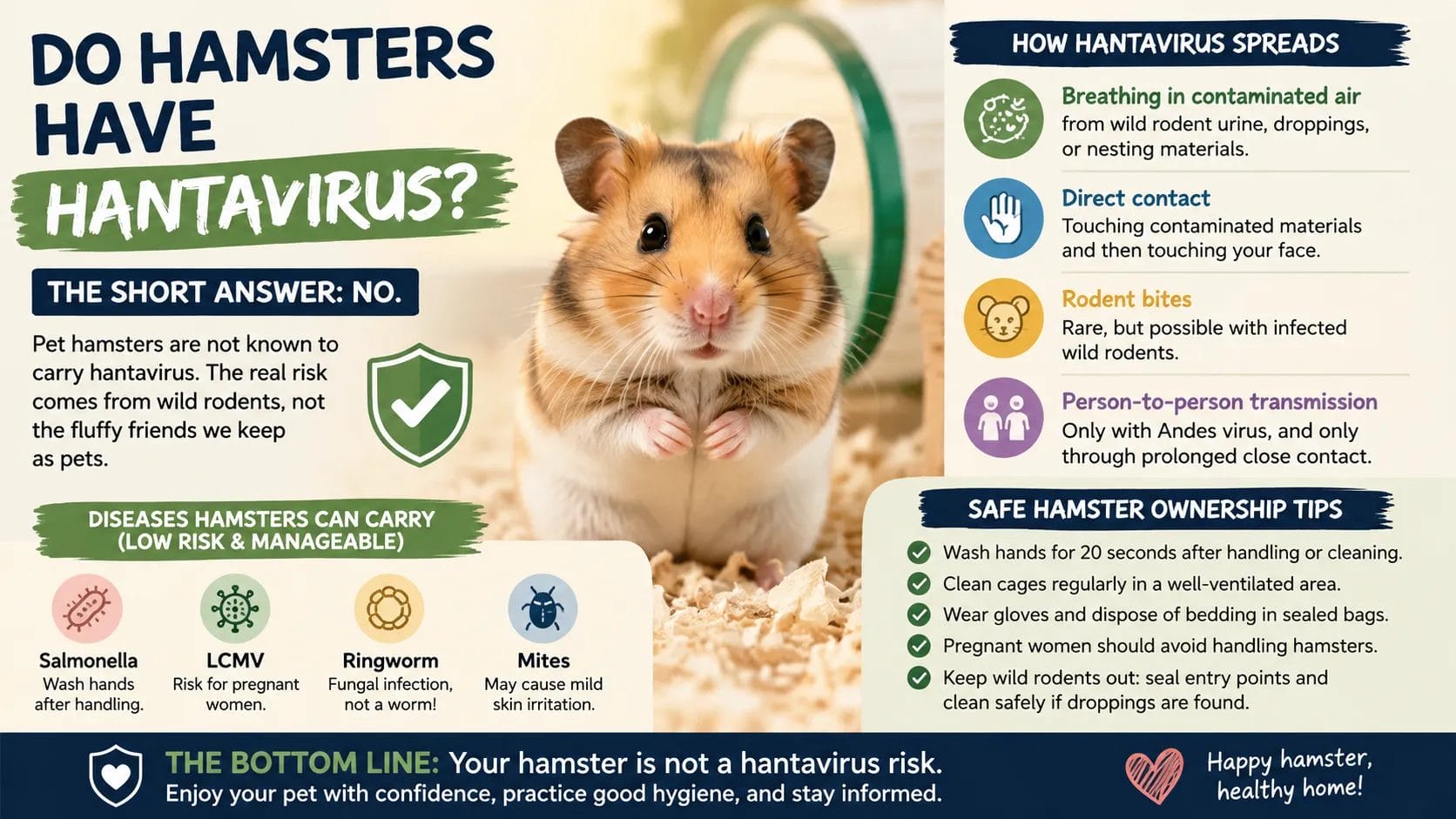
Here is the good news: pet hamsters are not known to carry hantavirus.
Health authorities, including the Centers for Disease Control and Prevention, say that hamsters, guinea pigs, and gerbils sold in pet stores are not considered hantavirus carriers. So your little hamster is far more likely to stuff food in its cheeks like a tiny hoarder than to spread this virus.
Why Wild Rodents Are the Real Risk?
The real danger comes from wild rodents, especially:
- Deer mouse
- White-footed mice
- Cotton rats
- Rice rats
These animals live in forests, barns, and fields and can carry hantavirus naturally.
Your pet hamster is a completely different story. Whether it is a Golden Syrian hamster or a dwarf hamster, it has been bred as a household pet for generations. It lives in a clean cage, runs on a squeaky wheel at 2 a.m., and has no connection to the wild rodents that spread hantavirus.
How Does Hantavirus Actually Spread to Humans?
Hantavirus usually spreads from wild rodents, not pets. The biggest risk happens when people breathe in tiny virus particles from fresh rodent pee, droppings, or nesting material — especially while sweeping dusty cabins, sheds, or storage spaces. Gross, but true.
It can also spread by:
- Touching contaminated surfaces and then touching your face
- Rarely, getting bitten by an infected wild rodent
- In very unusual cases, close person-to-person contact with someone infected with the Andes virus
So unless your hamster is secretly living in a forest cabin and hanging out with wild mice at night, your pet is not part of these risk scenarios.
The Andes Virus: Why Hantavirus Is in the News Right Now
The reason everyone is suddenly talking about hantavirus is a recent Andes virus outbreak linked to a cruise ship in the Atlantic Ocean. That sounds terrifying — because honestly, it is serious.
Here is what makes Andes virus different:
- It is found mainly in South America
- It comes from a wild rodent called the Long-tailed colilargo
- It is the only hantavirus known to sometimes spread between people through prolonged close contact
- There is no vaccine or specific cure yet
- Early symptoms look a lot like the flu, which makes it tricky to spot quickly
But here is the important part: this outbreak has absolutely nothing to do with pet hamsters. Your little fluff ball is still way more dangerous to your sleep schedule than to your health.
Hamsters in Hantavirus Research: An Important Distinction
You might see headlines saying scientists use hamsters to study hantavirus and think, “Wait… does that mean my hamster is dangerous?” Great question — but no.
Researchers sometimes use Syrian hamsters in high-security labs to study how hantavirus affects the body. These hamsters are deliberately infected under tightly controlled conditions, kind of like stunt doubles in a movie. They help scientists test treatments, but they are nothing like the furry roommate sleeping in your bedroom.
So if your hamster’s biggest crime is running on its wheel at 3 a.m., you have nothing to worry about.
What Diseases Can Hamsters Actually Transmit?
Hamsters are not linked to hantavirus, but like any pet, they can occasionally carry a few germs:
- Salmonellosis — Easy to prevent by washing your hands after handling your hamster or cleaning the cage.
- Lymphocytic choriomeningitis (LCMV) — Rare, but important for pregnant women to know about.
- Ringworm — Despite the creepy name, it is a fungus, not an actual worm.
- Mites — Tiny bugs that may cause mild itching.
The good news? These risks are uncommon and easy to manage with basic hygiene. In other words, your hamster is much more likely to steal sunflower seeds than cause a serious health problem.
How to Practice Safe Hamster Ownership
The good news? Your hamster is not a hantavirus threat. Still, a few simple habits will keep both you and your tiny furball healthy.
Daily Habits
- Wash your hands after handling your hamster or cleaning the cage
- Keep your hamster away from your face (yes, even if it looks ridiculously cute)
- Don’t snack while holding your pet
Cage Cleaning
- Clean the cage regularly in a well-ventilated area
- Wear gloves when dealing with dirty bedding
- Seal old bedding in a bag before throwing it away
For High-Risk Individuals
- Pregnant women should avoid handling hamsters because of the small risk of Lymphocytic choriomeningitis
- People with weakened immune systems should ask their doctor about safe pet care
If You See a Wild Rodent
This is where hantavirus actually becomes a concern. Never sweep or vacuum mouse droppings like in a horror movie scene. Wet the area with disinfectant, wear gloves, and clean carefully.
The Bottom Line: Pet Hamsters and Hantavirus Risk
Here is the truth every hamster owner should hear: pet hamsters do not carry hantavirus.
The real risk comes from wild rodents, not the fuzzy little creature stuffing sunflower seeds into its cheeks like a tiny grocery shopper. The recent Andes virus outbreak is serious, but it is linked to wild rodents in South America — not to pet hamsters.
So wash your hands, keep your hamster’s cage clean, and enjoy your adorable nighttime athlete with confidence. Your hamster is far more likely to wake you up with squeaky wheel marathons than to make you sick.

- Catahoula Leopard Dog: The Complete Guide to Louisiana’s State Dog - August 12, 2026
- Can Cats Eat Watermelon? What Every Cat Owner Should Know - August 10, 2026
- Lapponian Herder: The Complete Guide to Finland’s Reindeer Dog - August 5, 2026
GIPHY App Key not set. Please check settings